

PRODUCT OF THE WEEK!
KALI AUDIO SM8
8″ 3-Way 300W Active Studio Monitor with Network Control (Black, Single)
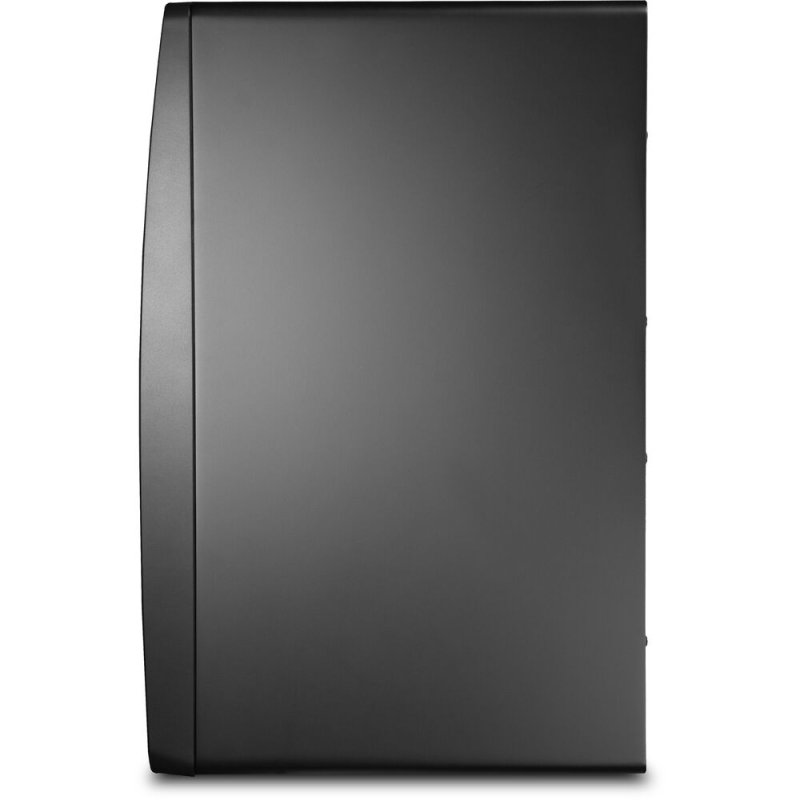
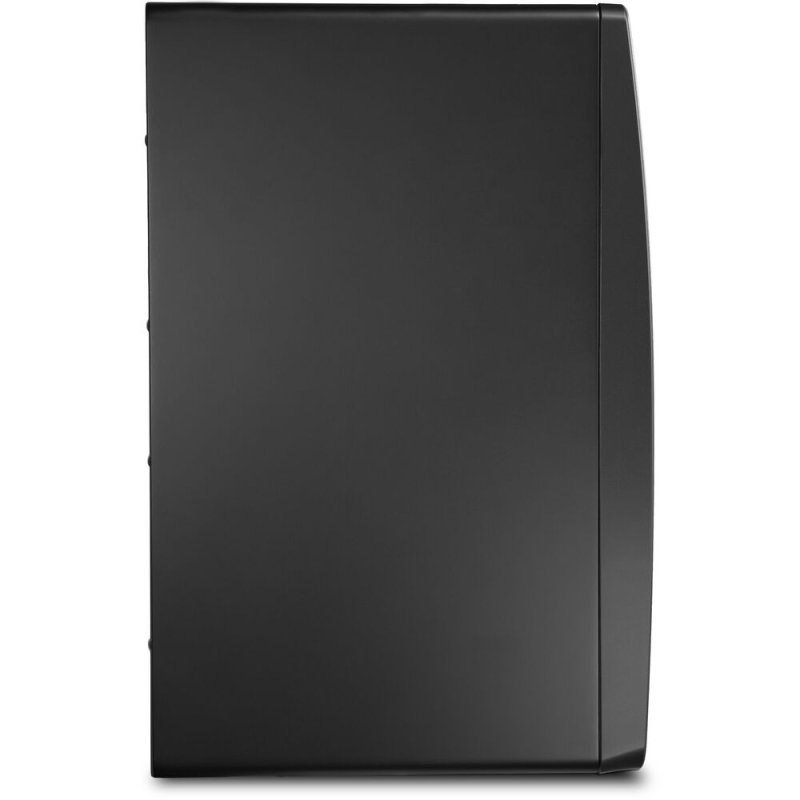
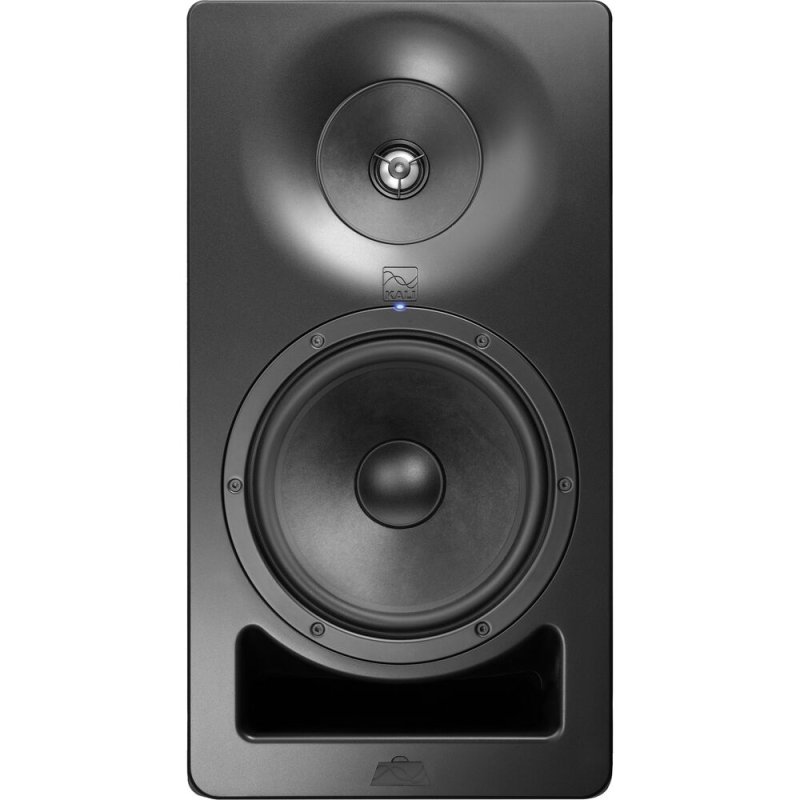
KALI AUDIO SM8 – 8″ 3-Way 300W Active Studio Monitor with Network Control (Black, Single)
Kali’s Flagship Active 3-way Point-source Monitor
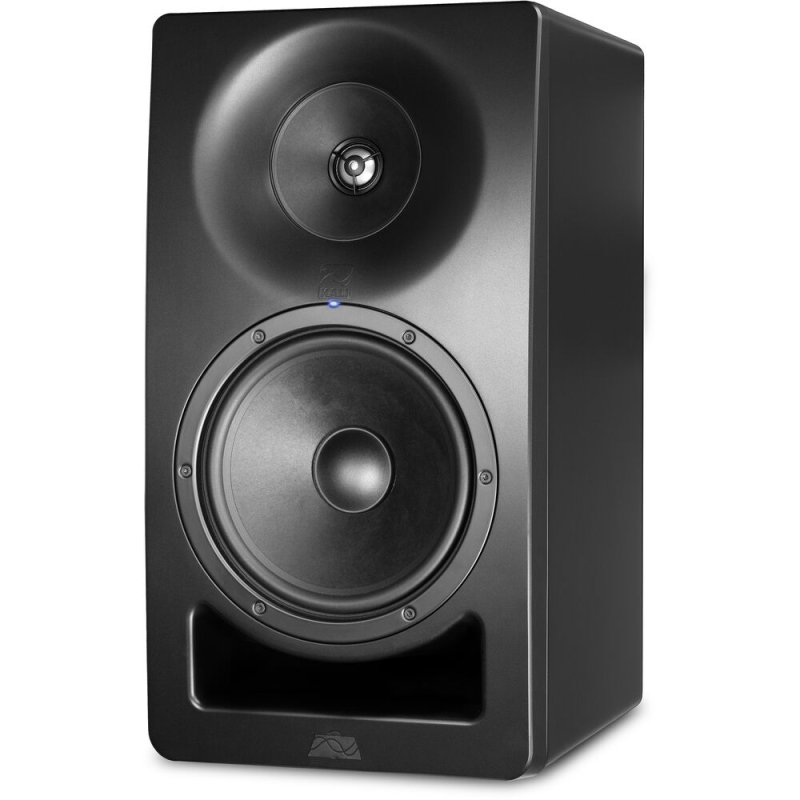
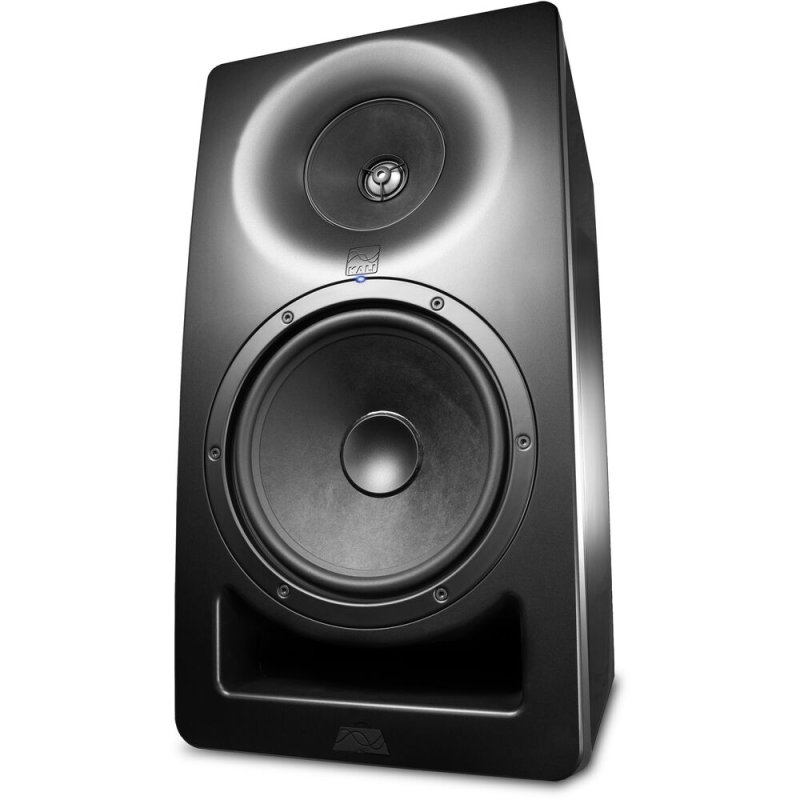
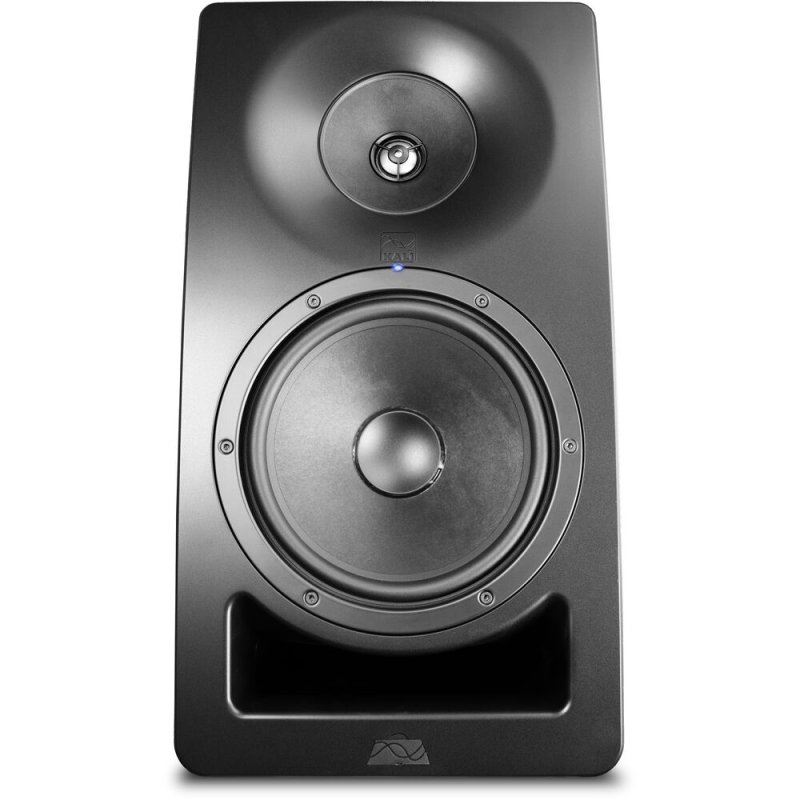
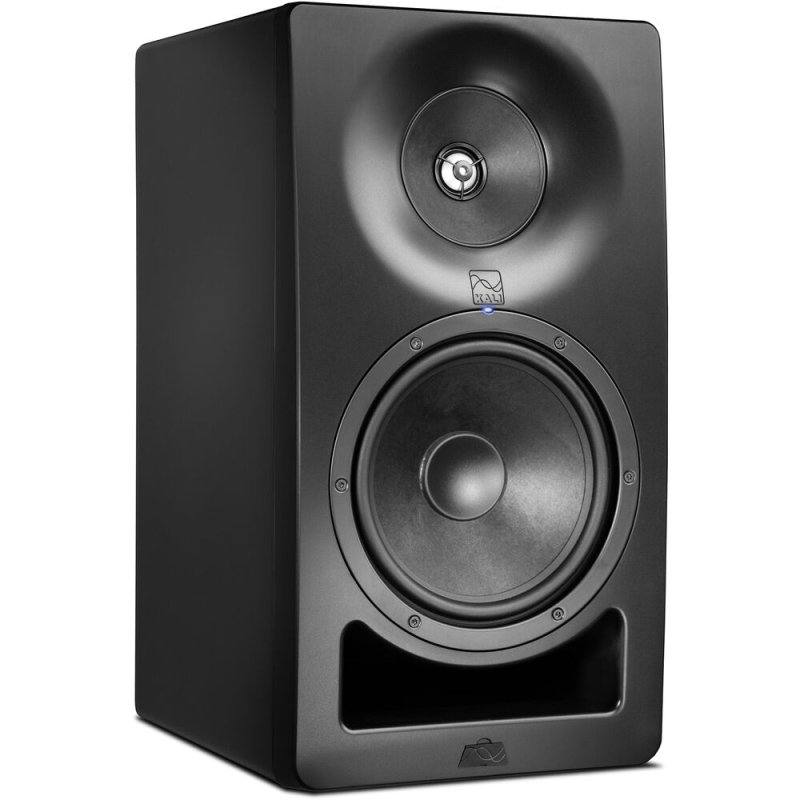
As the flagship of Kali Audio’s flagship Santa Monica series, the SM-8 active studio monitor combines the company’s proven 3-way coincident architecture with no-compromise components and cutting-edge DSP to deliver unerring monitoring accuracy over an extended frequency range with phase-coherent, point-source imaging across an expansive stereo soundstage. The latest iteration of this advanced technology, originally developed for Kali’s acclaimed IN series 3-way monitors, is now implemented in the SM series, elevating its already impressive sonic performance to the next level. The SM-8 incorporates a flux-stabilized 8-inch woofer and a 4-inch optimized-profile midrange driver assembly housing a coaxial 1-inch aluminum dome tweeter. Powered by 300 watts of state-of-the-art Class D triamplification, the system is integrated into a rigid, resonance-free front-ported cabinet with a sculpted low-diffraction baffle. The SM-8’s user-definable DSP parameters allow you to fully calibrate each speaker to your studio environment, while the Kali Control Panel app offers real-time control of EQ, delay, and trim functions, as well as locate, mute, solo, and dim functionality over an Ethernet network. Finally, the SM-8 comes ready to mount, enabling flexible placement in any studio.
Why 3-way?
There are many excellent 2-way monitor speakers on the market that, through clever engineering, have managed to mitigate many of the inherent drawbacks of 2-way designs. However, the fact remains that a well-engineered 3-way monitor will outperform such speakers at every turn. With a dedicated driver for the midrange frequencies (where the most critical aural information resides), 3-way speaker systems sidestep the Achilles’ heel of 2-way designs: namely, a crossover in the critical midrange — and the resultant burden placed on the woofer and tweeter of reproducing frequencies for which neither is ideally suited. An effective 3-way design is also capable of higher sound pressure levels — the SM-8 boasts an impressive maximum SPL of 119dB, enabling deployment in larger rooms. Lastly, we should note that the SM-8 does not exhibit off-axis acoustic lobing and the associated comb filtering effect that causes image smear due to frequency anomalies around the crossover point in typical 2-way designs.
Granted, considerations such as cost, room size, and listening distance will necessarily play a role in your selection of monitors, and for the majority of home desktop studios, small 2-way monitors make sense. Given a sufficient budget and space, the SM-8’s relatively compact form factor, coincident design, and high SPL handling provide versatility for use in midfield applications in larger control rooms. It can also serve as a main monitor in space-limited locations such as remote trucks or venue control booths, where its recessed input panel and front-ported design allow for flush wall placement (2π steradian spatial loading, a.k.a. half-space), which can be compensated for via the Kali Control Panel app.
Point source coherence
Kali Audio engineered each of the SM-8’s drivers to handle high SPLs effortlessly while maintaining a smooth response and vanishingly low distortion. The midrange driver is designed not only to handle its own frequency range optimally, but also to function as a waveguide for the aluminum dome tweeter, which features a proprietary geometry that reduces high-Q ultrasonic resonances to eliminate the harshness that plagues many metal-dome designs. To minimize baffle diffraction, the entire midrange/tweeter assembly is, in turn, integrated into a mathematically derived waveguide molded into the baffle, guaranteeing a seamless transition to the edges of the baffle in all directions. Typically used for tweeters in non-concentric designs, extending the benefit of waveguide mounting down to the midrange driver in the SM-8 provides a unique advantage by allowing the two drivers to function as a single point source, contributing to the SM-8’s optimized directivity, dispersion, and linear response through the critical mid- and high-frequency range. Inherent to point-source loudspeaker designs, time-domain alignment allows the sound from each driver to arrive at our ears simultaneously, which our brains process and interpret as a coherent musical soundstage.
Network control with Kali Control Panel app
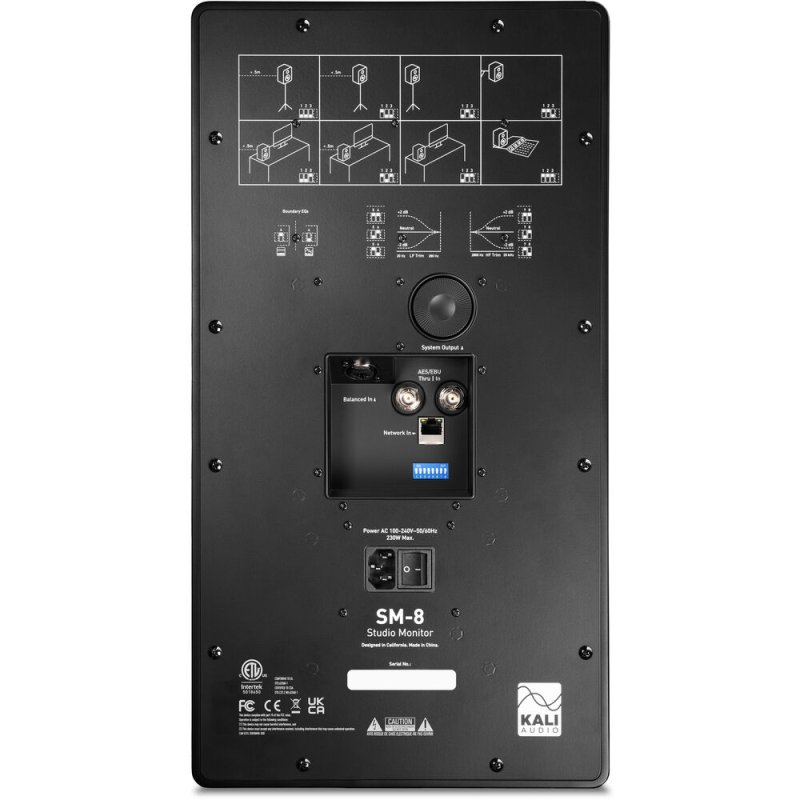
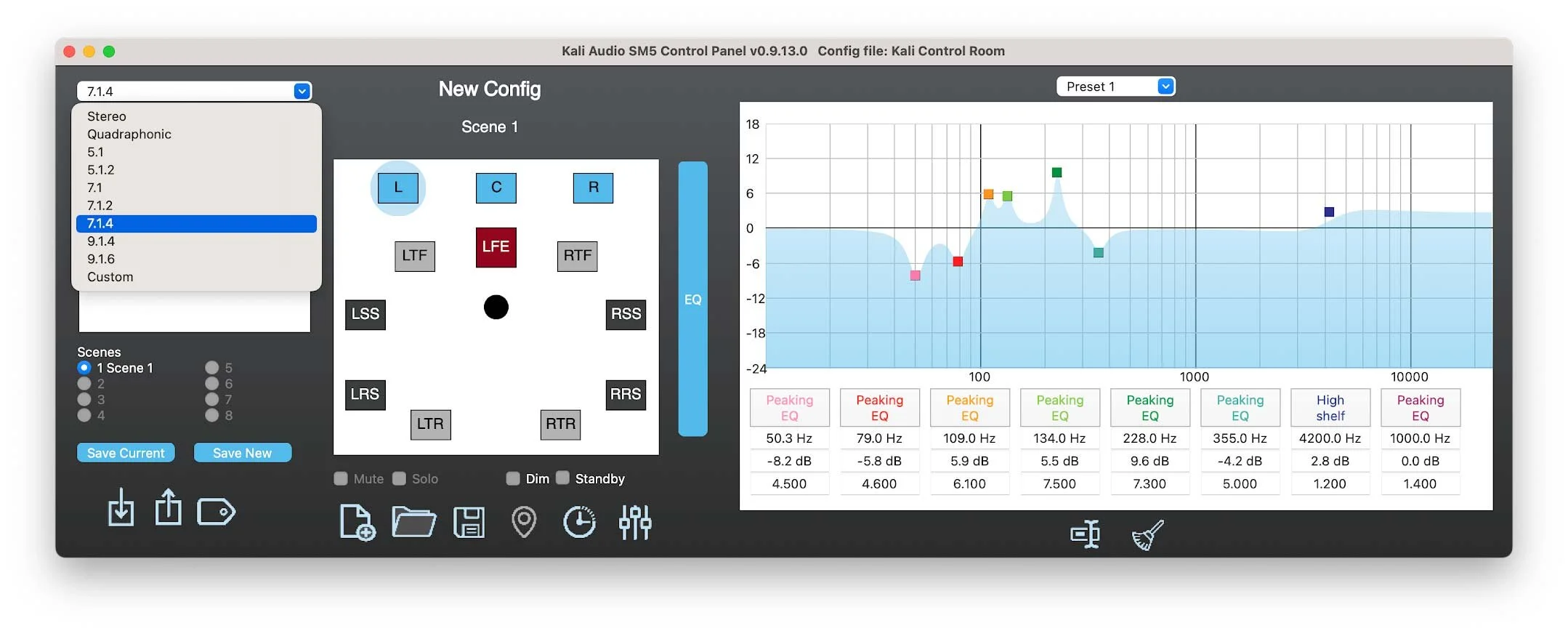
The SM-8 features neutral tuning and a DSP-powered limiter right out of the box, and you can access 8-band EQ, delay, and trim controls with user-definable parameters to calibrate each speaker to your studio and application. A rear-panel Ethernet port gives you access to these settings, as well as functions such as locate, mute, solo, and dim, right from the Kali Control Panel app. When networked, the SM-8 also enables you to switch effortlessly between scenes, allowing for button-press switching between whole-system tunings. The engineers here at Sweetwater have found that the SM-8’s network control will enable you to program configurations for different room EQ curves or different listening positions in the room on all the speakers in your setup — whether stereo, surround, or immersive audio — in one convenient step. Don’t have access to an Ethernet network? No problem. You can also load your settings to one speaker at a time using a thumb drive and the SM-8’s built-in USB port.
Mixes that translate
Experienced recording engineers know that there’s no substitute for midrange clarity in a monitor. This is the heart of your mix, and it remains relevant regardless of the playback system. That’s why you can spend hours struggling to achieve a perfect balance and end up with nothing but frustration, listening fatigue — and a mix that doesn’t “translate.” In addition to the outstanding midrange intelligibility and full-range coherence facilitated by the SM-8’s 3-way, coaxial architecture and meticulously designed crossover network, Kali’s ultra-rigid, front-ported cabinet also mitigates troublesome frequencies and eliminates port noise that can mask the midrange in other types of monitor speaker designs. As a result, you’ll find it’s easier to place, for instance, vocals and solo instruments in a mix, allowing you to achieve an ideal balance that translates to the world outside your studio and holds up well on real-world playback systems, where lackluster mixes go to die. The bottom line is that your monitors are the key to great-sounding recordings. Step up to world-class monitoring with the Kali Audio SM-
ROOM CALIBRATION
The SM-Series gives users full control of 8 parametric EQs, delay up to 12ms, and loudspeaker trim. These parameters can be accessed and edited using our Kali Control Panel application, available for both Mac and Windows.
Importantly, since these parameters are processed by the same DSP hardware already in line, using user-defined DSP adds no additional latency to the system. Total digital latency is acceptably low to allow tracking using the SM-Series.
Onboard calibration removes the need for a dedicated room calibration processor. It also prevents some of the confusion and mishap that is possible with a plug-in based processor. Calibration is available for any source you could plug into the speaker, without needing to route it through software, and it will never be active on a mix you print.
Kali has fully documented our recommended room calibration procedures. When you perform the measurement yourself, we can provide room tuning files for a small fee per speaker
More information can be found at Kaliaudio.com/santa-monica-how-to
SOFTWARE
User-editable DSP is available using Kali Control Panel software, available for both Mac and Windows. You may find links to download the latest version below.
Kali Control Panel works in both Online Mode, meaning that each speaker is connected to a network with an ethernet cable, or Offline Mode, meaning that you can use a USB thumb drive to load files onto the speaker.
MUCH more information may be found at kaliaudio.com/santa-monica-how-to
Kali Control Panel is currently in beta, and not all features may work as intended at this time.
MOUNTING
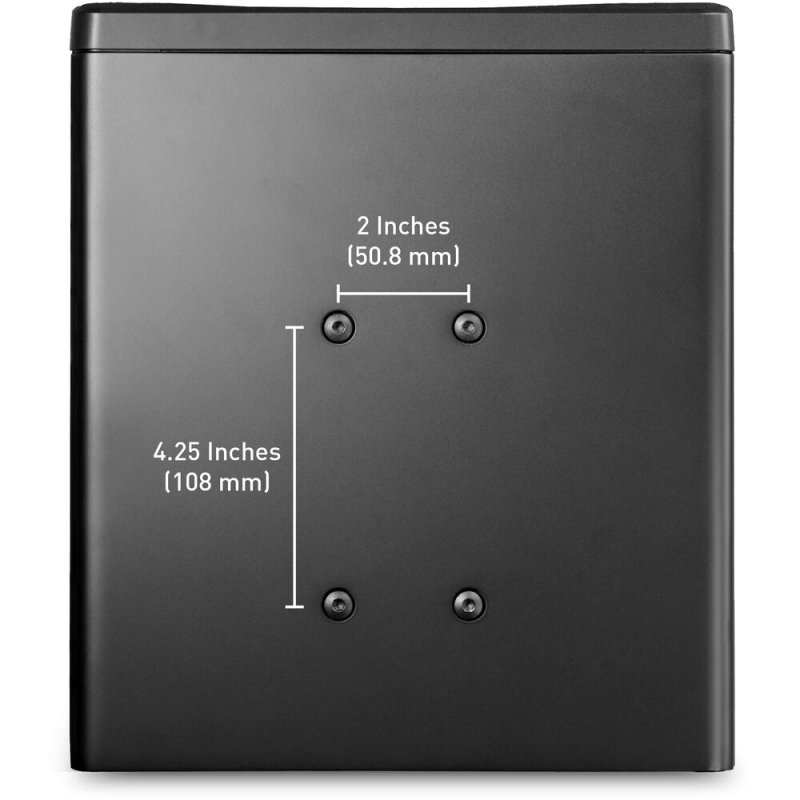
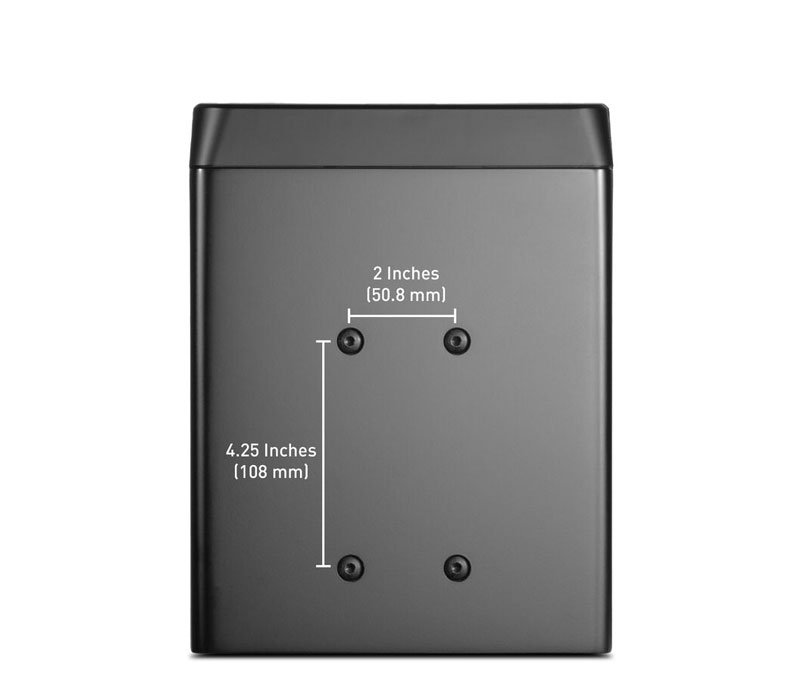
The SM–5 features mounting holes on both the top and bottom of the loudspeaker. Kali recommends using a speaker specific U-bracket from Triad-Orbit, but any speaker mount with a 4.25 x 2-Inch bolt pattern that is capable of holding the SM-5’s 21 lbs weight will also work.
Specifications
- Self-Powered: Yes
- Amplifier: 3-Channel Class D (discrete LF, MR, and HF)
- Amplifier Power: 300 W
- HF Driver: 1-Inch Metal Dome Tweeter
- Midrange Driver: 4-Inch Optimized Profile Paper Cone
- LF Driver: 8-Inch Optimized Paper Woofer
- LF-to-Midrange Crossover: 280 Hz
- Midrange-to-HF Crossover: 2800 Hz
- Frequency Response (-10 dB): 37 Hz – 35 kHz
- Frequency Range (+/-3 dB): 47 Hz – 21kHz
- Recommended Listening Distance: Up to 5 Meters
- Max SPL (Peak at 1 meter): 119 dB
- Loudspeaker THD (90 dB SPL at 1 meter): <0.5%
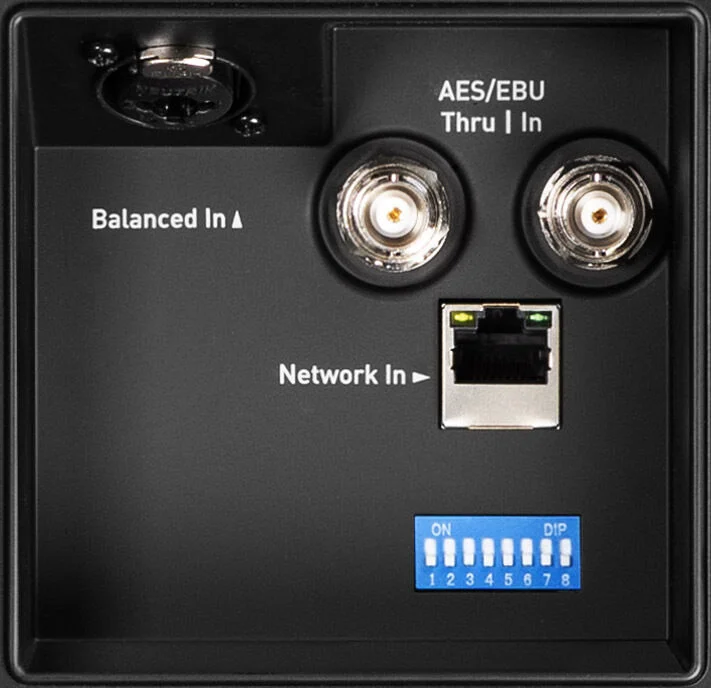
- Audio Inputs: Balanced Analog over XLR | AES/EBU over BNC
- Control Inputs: Ethernet (RJ45) USB-A
- Other I/O: AES/EBU over BNC Thru AC Power Input
- User-Definable DSP (Per Loudspeaker): 8 Parametric EQs | 10 ms of delay| -12 to +6 dB trim
- Enclosure: Front Ported
- DSP latency: <3ms
- Product Height: 19 Inches (48.26 cm)
- Product Depth: 12 Inches (30.5 cm)
- Product Width: 10 Inches (25.4 cm)
- Product Weight:32 lbs (14.5 kg)